The world of Industrial IoT (IIoT) is full of dazzling promises—efficiency gains, zero downtime, and massive cost savings. But for managers and engineers who aren’t experts in radio frequency, cloud computing, or vibration analysis, the whole concept often feels like a giant, expensive leap of faith. It sounds great, but where do you actually start? And how do you make sure the technology you implement today connects with the legacy systems you rely on tomorrow?
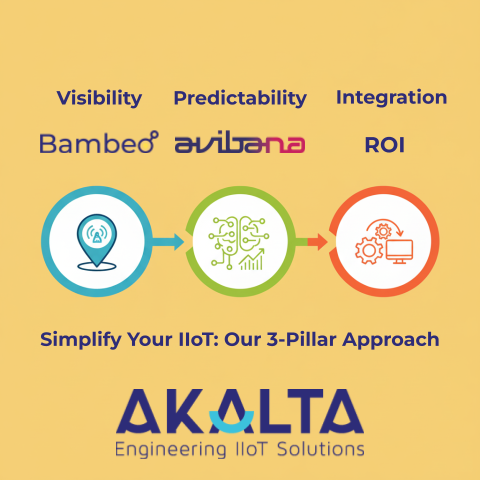
At Akalta, we understand that complexity kills adoption. That’s why we’ve built our entire business around a simple, three-pillar approach to Industrial IoT. We don’t ask you to overhaul your entire operation overnight. Instead, we offer clear, practical steps to move from guesswork and manual tracking to real-time visibility and true predictability.
If you’re looking to transform your assets from silent, unreliable resources into intelligent, proactive components of your business, this is the approach that works.
Pillar 1: Total Asset Visibility (Knowing What and Where)
The foundation of any successful IIoT strategy is answering the most basic, yet often hardest, question: “What do I have, and exactly where is it right now?”
In the industrial world, this problem is rampant. Machinery goes missing, tools are left on job sites, and inventory counts are perpetually wrong. This problem of “dark assets”—assets that exist but are invisible to your management systems—creates operational chaos, inventory shortages, and unnecessary capital expenditure.
The Technology That Eliminates Manual Tracking
To achieve total visibility, you must move beyond the limitations of the barcode, which requires a human to locate and scan an item one at a time visually. We use smart technologies that are fast, automatic, and error-proof:
- RFID (Radio Frequency Identification): Think of RFID tags as “smart labels.” Unlike barcodes, you don’t need a direct line of sight to read them. An RFID reader can instantly count and identify dozens or even hundreds of items simultaneously—even if they’re still in boxes or packed on a pallet. This capability eliminates the time and error associated with manual inventory counting.
- RTLS (Real-Time Location Systems): RTLS is essentially a secure “indoor GPS” for your facility. By placing small, low-power transmitters (tags, often using Bluetooth Low Energy) on your high-value assets and installing readers or antennas throughout your facility, you can constantly track the location of those assets down to the room, zone, or even shelf. This is critical for preventing loss and reducing the time spent searching for equipment.
How Bambeo Delivers Visibility
Our Bambeo platform is the central brain built to manage these identification and tracking technologies. Bambeo focuses on the identification, tracking, traceability, and management of assets or people within production processes.
Bambeo takes the raw data streaming in from RFID and RTLS readers and converts it into actionable business intelligence:
- Real-Time Inventory and Location: Bambeo maps the live location of every tagged item onto a digital layout of your facility. A manager or technician can instantly see the exact location of a tool, a container, or a component on a simple dashboard, eliminating search time and preventing duplicate purchases of “lost” items.
- Traceability and Process Control: In manufacturing or logistics, knowing when an asset moved is as important as knowing where it is. Bambeo automatically logs every movement through “virtual checkpoints” (e.g., dock doors, assembly gates) created by fixed RFID readers. This ensures complete traceability, verifying that an item has completed all necessary steps in a production process before moving on.
- Simplified Human Interaction: Our solutions are designed to minimize human error. Instead of scanning manually, a technician simply pushes a cart of tools past a checkpoint, and Bambeo automatically verifies the inventory and updates its location, freeing up staff to focus on higher-value tasks.
Pillar 2: Predictive Insight (Knowing How and When)
Achieving total asset visibility (Pillar 1) is great, but it only tells you what is happening. The next level of IIoT maturity is achieving Predictive Insight, which means knowing how your machine is feeling and when it will fail.
For years, companies relied on two costly maintenance strategies:
- Reactive Maintenance (The Firefighter): Waiting for a catastrophic breakdown. This causes massive unplanned downtime and expensive emergency repairs.
- Preventive Maintenance (The Guesswork): Scheduling maintenance on a fixed calendar (e.g., changing a pump bearing every 6 months). This wastes money by replacing parts that still have life left or, worse, by missing hidden problems that develop between service dates.
Predictive Maintenance (PdM) shifts the strategy to Condition Monitoring (CM). This is where IoT sensors give your machines a voice to report their own health status.
The Technology That Gives Machines a Voice
- IoT Sensors: These are the ears and eyes of the PdM system. They constantly measure key physical parameters like vibration, temperature, pressure, and current. A slight increase in temperature or an abnormal vibration pattern is a machine’s early symptom of impending failure.
- Advanced Analytics: Raw sensor data is useless without context. The platform must be able to analyze this complex data (especially vibration data) to identify patterns, calculate diagnostic parameters (like Crest Factor or Overall RMS), and compare them against established healthy benchmarks.
How Avibana Delivers Predictability
Our Avibana platform is the dedicated engine for Condition Monitoring and Predictive Maintenance. Avibana takes the high-frequency data from your industrial sensors and turns it into clear, actionable advice:
- Data Aggregation and Analysis: Avibana captures both scalar data (simple measurements like temperature) and dynamic data (complex measurements like vibration waveforms) from your IoT sensors. It automatically processes this data, providing engineers with the necessary analysis tools (like spectral analysis) to understand why a machine is struggling.
- The Early Warning System: This is where the financial value of PdM is realized. Users define smart alarms and thresholds within Avibana. If a machine’s health metric (say, its vibration level) crosses a warning threshold, Avibana sends an instant notification. This allows your team to schedule a repair 30 days in advance during a planned shutdown, eliminating unplanned downtime.
- Asset Lifecycle History: Avibana doesn’t just look at the present; it maintains a complete, auditable history of the asset’s condition. This allows maintenance teams to see deterioration trends over months or years, supporting smarter decisions about when an asset needs retirement, replacement, or overhaul.
Pillar 3: Integration and Scalability (The Smart Foundation)
Many companies get excited about a technology (like a sensor) only to find it lives in a silo, disconnected from their core business systems. Our core approach is to build solutions that are interoperable and scalable from day one.
The Challenge of the Legacy System
The reality of industrial environments is that they rely on legacy systems—your ERP (Enterprise Resource Planning) handles purchasing and finance, your CMMS (Computerized Maintenance Management System) handles work orders, and your SCADA system handles control. A new IoT solution must integrate with these systems; otherwise, its value is lost. You don’t want your technician to find a problem in Avibana, but then have to manually log into the CMMS to create the work order.
Akalta’s Integration-First Philosophy
This is perhaps the most important pillar of our approach: Akalta builds our platforms to be flexible and connectable.
- Standardized Interfaces: Both Bambeo and Avibana utilize industry-standard interfaces like REST APIs (for business management systems) and MQTT (for industrial detection devices). This means your existing IT infrastructure doesn’t have to be completely replaced; our platforms can communicate with it directly.
- Solving the Healthcare Example: Even in complex sectors like healthcare, our approach holds. For example, Bambeo includes a basic HL7 server interface—the standard for hospital data exchange. This allows our asset tracking solution to communicate seamlessly with hospital information systems (HIS), proving our commitment to integrating new IIoT data into critical legacy processes.
- Start Small, Grow Big: We eliminate the high initial implementation costs often associated with IIoT. Our solutions are designed to be highly scalable, allowing clients to tag and monitor only the most critical or problematic assets first. Once the return on investment is proven, the solution can be seamlessly expanded across the entire facility or global operations without needing a complete overhaul of the platform.
The Combined Power of Bambeo and Avibana
Our two platforms, Bambeo and Avibana, represent the comprehensive two-sided approach to IIoT:
- Bambeo answers the logistical questions: What and Where. It ensures inventory is accurate and processes are followed.
- Avibana answers the engineering questions: How and When. It ensures equipment health is maintained and failures are prevented.
Crucially, because both are built by Akalta, they are designed to share information. A maintenance work order created in your CMMS (integrated via Bambeo) can be automatically linked to the vibration history in Avibana, creating a closed-loop system of asset intelligence.
Conclusion: Turning Cost Centers into Strategic Assets
The journey into Industrial IoT doesn’t have to be a blind jump into a technological abyss. Our approach is grounded in practicality, scalability, and integration.
We believe that the best IIoT solution is the one that simplifies operations, eliminates manual error, and delivers quantifiable ROI by leveraging your data to ensure visibility and predictability. By focusing on the three pillars—Total Visibility, Predictive Insight, and Seamless Integration—Akalta gives you the tools to transform your industrial assets from costly, unpredictable drains on your budget into strategic, intelligent assets that drive efficiency and profitability.