The promise of the Smart Factory sounds like science fiction: machines talking to each other, zero errors, perfect predictive maintenance, and production lines that self-adjust. While the concept is ambitious, the reality is that many manufacturing companies feel overwhelmed by where to start with Industry 4.0 and the Industrial IoT (IIoT).
The problem is not the lack of technology, but the lack of a practical plan. Often, companies invest in sensors or software without a unified framework, creating “islands of automation” that fail to communicate with each other. The result: costly investment with minimal return.
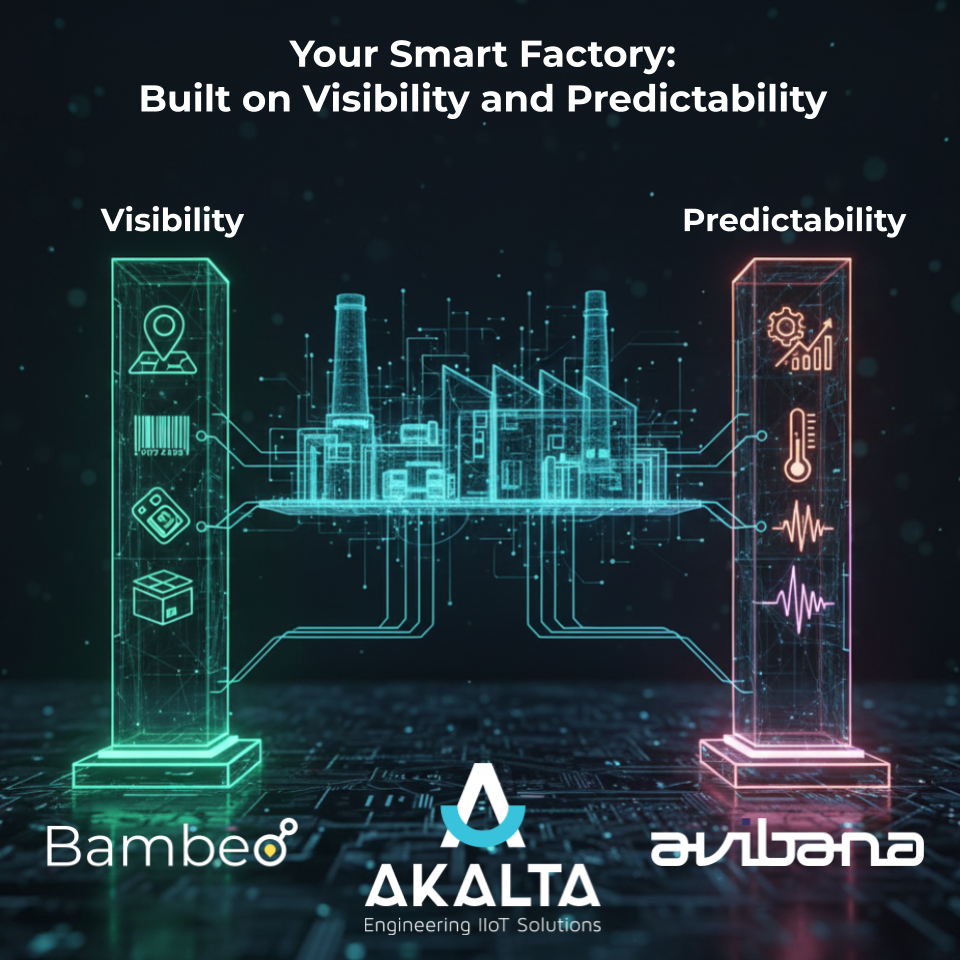
At Akalta, we understand that the Smart Factory is built on two fundamental pillars: Knowing Where Everything Is (Visibility) and Knowing How Everything Is (Predictability). It’s not just about high technology, but about connecting data from your physical assets with operational intelligence.
This article is aimed at those taking their first steps in industrial digitization. We will demonstrate that transformation is a step-by-step journey and how Akalta’s Bambeo and Avibana platforms provide the essential tools to build a smarter, more efficient, and more profitable factory.
The Diagnosis: Why the Traditional Factory Hits a Wall
The traditional factory, which relies on spreadsheets, visual inspections, and reactive or calendar-based preventive maintenance, has inherent limitations that the Smart Factory seeks to eliminate:
1. Operational Blindness (The Where Problem)
- Loss of Tools and Assets: How much time do your technicians waste searching for specialized tools, molds, or work-in-progress (WIP) containers? Loss and misplacement necessitate constant investment and increase delays.
- Inaccurate Inventory: Manual inventory counting or the use of slow barcodes leads to discrepancies, forcing you to maintain expensive safety stocks to prevent stoppages.
- Difficult Traceability: Determining exactly which machine, tool, or batch of material was used to manufacture a specific product is slow and error-prone, risking regulatory compliance.
2. Production Uncertainty (The When Problem)
- Unplanned Downtime: Relying on reactive maintenance (waiting for something to break) is the biggest enemy of efficiency. Every unplanned failure costs thousands or millions of dollars in lost production and penalty fees for delays.
- Inefficient Maintenance: Time-based preventive maintenance (replacing a part every six months) wastes money by changing components that still have life left.
The Smart Factory uses the Industrial IoT (IIoT)—which is simply a network of smart sensors and tags—to eliminate this blindness and uncertainty.
Step 1: Laying the Foundation for Intelligence with Bambeo (Visibility)
Before you can predict failures, you must know where everything is. Total Visibility is the first pillar of the Smart Factory. This is where Bambeo comes in: Akalta’s platform focused on the identification, tracking, and traceability of physical assets and processes.
Bambeo uses technologies that give your assets a “voice and a GPS” without the need for manual intervention:
A. Instant Traceability with RFID and Barcodes
- Goodbye to One-by-One Scanning: Bambeo integrates with RFID (Radio Frequency Identification) technology. Imagine being able to instantly count an entire cart of tools or a complete batch of components just by passing a reader. This eliminates the slowness and errors of traditional barcodes.
- Real-Time Inventory Visibility: By placing fixed RFID readers at strategic points (warehouse doors, line entrances), Bambeo automatically registers when an asset moves from one zone to another, maintaining real-time inventory with near 100% accuracy.
B. Real-Time Location (RTLS)
- The Indoor GPS: For high-value assets that move constantly (forklifts, autonomous vehicles, specialized tools), Bambeo uses technologies like Bluetooth Low Energy (BLE) to implement Real-Time Location Systems (RTLS).
- Reduced Search Time: Staff can consult an application or a Bambeo dashboard to see the exact location of an asset on a digital factory map, eliminating searches and increasing productivity.
C. Process Automation (ProcessLog)
- Error-Free Traceability: In the Smart Factory, traceability is automatic. Bambeo records the complete history of a product or batch through its ProcessLog. If a container of components enters assembly line C, Bambeo logs it, ensuring the chain of custody and facilitating quality audits.
- Event and Task Management: Bambeo allows associating states (“Available,” “In Use,” “Under Maintenance”) with assets and automating notifications when certain conditions are met (e.g., a tool is returned to the wrong location).
In short, Bambeo gives you total logistical control. It tells you what you have and where it is every second.
Step 2: Achieving Operational Excellence with Avibana (Predictability)
Once you know where everything is, the next step is to ensure your machines are healthy and ready to work. This is where Condition Monitoring (CM) and Predictive Maintenance (PdM) come into play, facilitated by the Avibana platform.
Avibana is the brain for your machines’ health, transforming raw sensor data into early warnings.
A. The Voice of the Machinery (IoT Sensors)
- Early Detection: Avibana integrates with IoT sensors that constantly measure vital parameters of your machinery: vibration, temperature, pressure, and energy consumption. These sensors are what give the machine its “voice.”
- Focus on Vibration: For rotating equipment (motors, pumps, fans), vibration is the most important health indicator. Failures in bearings or misalignment manifest as subtle changes in vibration long before a noise is heard or the temperature rises.
B. Advanced Analysis for Clear Decisions
- Industrial Vibration Diagnostics: Avibana doesn’t just capture data; it uses advanced algorithms to analyze complex vibration signals, generating diagnostics like the frequency spectrum or the automatic calculation of key parameters such as Overall RMS and Crest Factor.
- Smart Alerts: The true value of PdM lies in the alert. Avibana allows your engineers to define smart alarm thresholds based on the machine’s actual condition. If a machine’s health metric (say, its vibration level) crosses a “Warning” threshold, Avibana sends an instant notification.
C. Eliminating Unplanned Downtime
- Condition-Based Maintenance: Upon receiving an early alert from Avibana, your team can schedule the repair (changing the bearing, for example) during a planned shutdown, rather than waiting for a catastrophic failure. This reduces the cost of repair and eliminates the impact on production.
- Asset Health History: Avibana maintains a detailed history of each machine’s health. This helps reliability engineers understand failure patterns, optimize service intervals, and ensure parts are replaced only when necessary (Condition-Based Maintenance).
Step 3: Connecting the Intelligence (Integration)
The true Smart Factory is achieved when Visibility (Bambeo) and Predictability (Avibana) converge and communicate with your existing systems.
Akalta designs its platforms to be agnostic and open, using industry standards like REST API to ensure seamless integration:
- Avibana to CMMS: If Avibana detects a vibration alarm, it can automatically generate a work order in your Computerized Maintenance Management System (CMMS, such as SAP PM or Maximo), without manual intervention.
- Bambeo to ERP: When Bambeo records the arrival of a batch of tagged components, it can notify your Enterprise Resource Planning (ERP) system to update inventory and automatically release the work order for that batch.
- The Closed Loop: If a tool leaves the production line and Bambeo registers it in the repair area, Avibana can automatically consult that tool’s history before the technician begins service.
This information integration is what transforms isolated technology into a total operational advantage, closing the information loop between physical operation, maintenance, and financial management.
Conclusion: Building the Smart Factory at Your Pace
The path to the Smart Factory does not require a multi-million dollar investment overnight. It requires a strategic and modular approach.
Akalta provides the two essential pieces of this puzzle:
- Bambeo gives you the Visibility and Traceability you need to control your inventory, tools, and processes.
- Avibana gives you the Predictability you need to eliminate unplanned downtime and optimize your maintenance.
By implementing these solutions step-by-step, leveraging IIoT technology practically and with a vision for integration, you can transform your plant from a factory of reaction to a factory of foresight—one that produces more with less risk and total control over every asset.