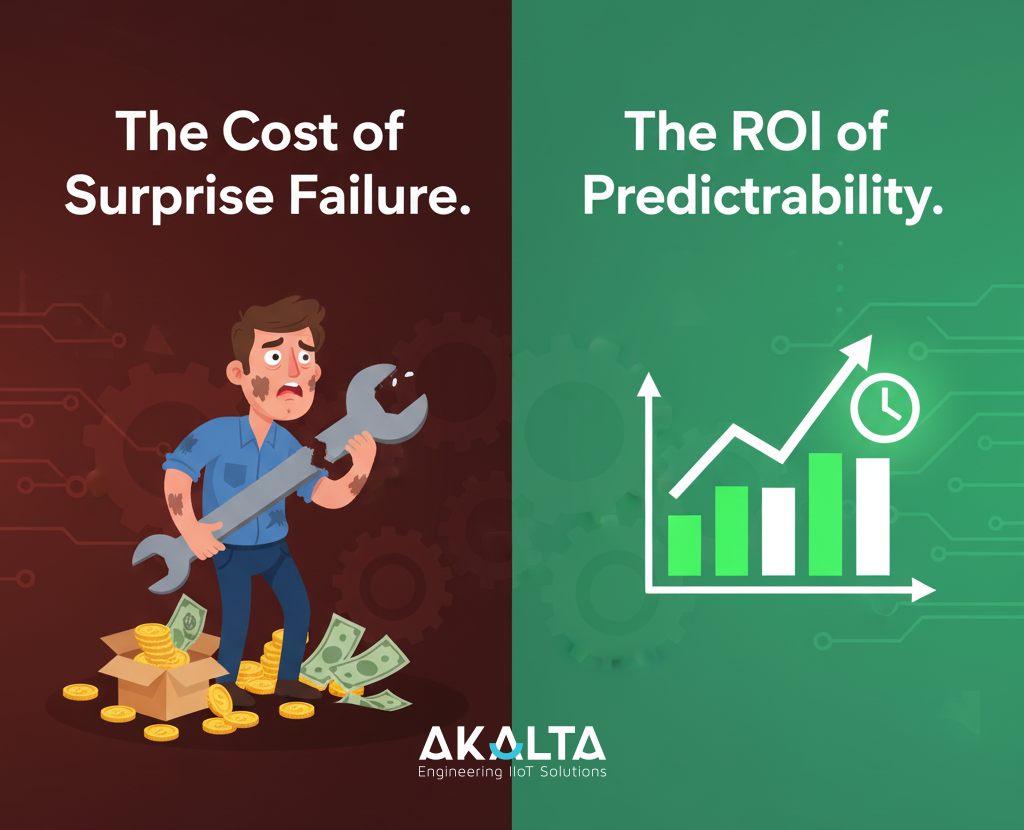
The Wallet Whisperer: Why Predictive Maintenance is the Best Financial Decision You Can Make
Every business relies on equipment. Whether you run a bustling manufacturing plant, manage a fleet of service vehicles, or oversee complex machinery in a utility company, your assets are the backbone of your operation. When those assets fail, your business stops, and your profits evaporate.
For years, companies have dealt with equipment failure in one of two ways:
- Reactive Maintenance (“If It Breaks, Fix It”): You wait until a machine completely fails, production stops, and then you scramble to fix it. This is costly, stressful, and entirely unpredictable.
- Preventive Maintenance (“Fix It Anyway”): You schedule maintenance at fixed intervals—say, every three months—regardless of whether the machine needs it or not. This is better than reactive maintenance, but it’s inefficient, as you often replace parts that still have life left or miss hidden problems that crop up between service dates.
Both of these traditional approaches are massive drains on your budget.
But what if there was a third, smarter way? A method that uses technology to predict when a problem is coming, giving you the power to act before disaster strikes?
That is the essence of Predictive Maintenance (PdM), and it is hands down the best financial decision you can make for any operation that depends on machinery. This isn’t just a maintenance strategy; it’s a profitability strategy. In this article, we’ll break down the powerful financial benefits of PdM, demystify the technology that makes it possible, and show how a platform like Avibana delivers this value directly to your bottom line.
Part 1: Calculating the Financial Toll of Traditional Maintenance
Before you can appreciate the gain, you have to recognize the financial bleeding caused by the old methods.
The Cost of Reactive Maintenance (The “Firefighter” Approach):
- Massive Downtime Losses: This is the single biggest expense. When a critical machine breaks down unexpectedly, production halts instantly. Every hour lost is lost revenue, plus the compounding cost of salaries paid to idle workers. A major failure can cost tens of thousands of dollars per hour.
- High Repair Costs: Emergency repairs cost more. You pay premiums for rush service, expedited shipping for parts, and overtime for technicians. A planned repair is always cheaper than a panicked one.
- Secondary Damage: When a small part fails (like a bearing), the machine often keeps running until the failure spreads, destroying more expensive components (like a shaft or motor). The minor issue turns into a total equipment overhaul, ballooning the cost.
The Cost of Preventive Maintenance (The “Guesswork” Approach):
- Wasted Useful Life: You replace a bearing every 1,000 hours because the manufacturer recommends it. But what if that specific bearing, in your specific operating conditions, could last 2,000 hours? You’re throwing away perfectly good equipment, which is a waste of capital and labor.
- Unnecessary Labor: Your team spends time performing inspections and swapping out parts that didn’t need attention. This valuable time could be better spent on strategic improvements or other productive tasks.
- Induced Failures: Believe it or not, deep-diving into a machine for maintenance is often the moment a new problem is introduced. A loose bolt or a misaligned component can sometimes trigger the next breakdown.
Part 2: The ROI of Predictive Maintenance
Predictive maintenance uses smart sensors—part of the Internet of Things (IoT)—to continuously monitor the health of your equipment. It collects data on things like vibration, temperature, pressure, and sound. Powerful software analyzes this data to look for the subtle “symptoms” that indicate a problem is developing.
The financial return on this investment is transformative:
- Dramatic Reduction in Downtime (The Biggest Win):
This is the heart of the ROI. PdM shifts maintenance from “unplanned” to “planned.” Instead of a catastrophic failure, you receive a notification that a component has, for example, 30 days of life left. This allows you to schedule the repair during a natural break in production (like a weekend or a planned shift change). This minimizes, or even eliminates, costly, unexpected downtime. - Optimizing Maintenance Resources (Cutting Labor Costs):
With PdM, you only perform maintenance when it is actually needed. This is called Condition-Based Maintenance (CBM). Your maintenance team stops wasting time on healthy machines and focuses its efforts entirely on the machines that are actively showing signs of distress. This dramatically increases the efficiency of your maintenance staff, allowing them to handle more assets without adding headcount. - Extending Asset Lifespan and Reducing Capital Expenditure:
By identifying and fixing small problems early, you prevent them from escalating into large, destructive failures. This preserves the health of your primary equipment (motors, pumps, gearboxes) and extends their overall lifespan. When you prolong the life of expensive assets, you delay the need for massive capital expenditure on replacements. - Reduced Spare Parts Inventory:
When you know a specific part needs replacing in a few weeks, you don’t need to keep a massive inventory “just in case.” You can order the part precisely when you need it, cutting down on the capital tied up in expensive spare parts sitting on a shelf and freeing up valuable warehouse space. - Better Energy Efficiency:
A machine that is starting to fail (e.g., a pump with a worn bearing) has to work harder and consumes more energy to produce the same result. PdM identifies these inefficiencies, allowing you to fix the underlying problem, which results in a direct, measurable saving on your energy bill.
Part 3: Avibana: Your Predictive Maintenance Engine
You don’t need to be a data scientist to implement a successful PdM program. Modern platforms are designed to be user-friendly, translating complex sensor data into clear, actionable advice. Avibana is an asset health condition monitoring platform built specifically to deliver this value.
How Avibana Delivers Financial Value:
- It gathers the “Symptoms”: Avibana uses IoT-enabled sensors (including specialized vibration and ultrasound sensors) to constantly collect data from critical measurement points on your assets. It can also collect data from offline readers, ensuring all your assets are covered. This constant stream of information is the foundation of the financial return.
- It diagnoses the problem: The platform doesn’t just collect data; it analyzes it. It automatically calculates derived parameters (like overall RMS, a measure of vibration severity) that are critical indicators of a machine’s health. This analysis tells you what is wrong, not just that something is wrong.
- It alerts you with time to act: This is where the ROI is secured. Avibana lets you define alarms and thresholds. When a machine’s “symptoms” cross a safety or warning threshold, the system immediately sends a notification. This early warning system gives your team the critical time needed to plan the repair during an optimal maintenance window, maximizing uptime.
- It simplifies complex data: All the complex sensor data is presented on customizable dashboards with clear trend charts and visual indicators. You can track asset performance and historical condition without needing specialized expertise. This quick, intuitive understanding of asset health allows non-experts to make smart, profitable decisions.
- Asset Lifecycle Management: Avibana is also built to help manage the complete asset lifecycle. It keeps a history of all measurements, failures, and repairs. This historical data is essential for accurate maintenance planning and determining the optimal time to replace an aging asset, preventing premature disposal.
The Final Word: Making the Shift to Profitability
The financial argument for predictive maintenance is overwhelming. The investment in an IoT-based PdM solution is quickly recouped through a combination of reduced downtime, minimized repair costs, extended asset lifespan, and optimized labor resources.
By making the shift to a platform like Avibana, you move away from the stress and expense of emergency repairs. You gain a powerful strategic advantage by ensuring your operations are consistently reliable, efficient, and predictable. For any business that relies on machinery, adopting a tool that provides true condition-based intelligence is no longer a luxury—it is a clear path to improved financial health and long-term profitability.