In the high-stakes world of manufacturing, every second of unplanned downtime, every misplaced tool, and every inaccurate inventory count translates directly into lost revenue. Modern factories are complex ecosystems where thousands of assets—from specialized tools and calibrated gauges to robotic arms and high-volume production machinery—must function in perfect, coordinated harmony.
For too long, the control of these vital physical assets has relied on manual, reactive, and error-prone methods: clipboards, spreadsheets, visual checks, and reliance on operator memory. This outdated approach creates a silent drain on profitability, resulting in wasted time, unnecessary capital expenditures, and a constant state of operational firefighting.
The solution is not more human effort, but the strategic application of Automated Asset Control (AAC), powered by the Industrial Internet of Things (IIoT).
Automated Asset Control is the transformation of your physical assets from passive, silent objects into intelligent, proactive components that constantly report their location, operational status, and health. It is the core concept that moves manufacturing from chaotic guesswork to total visibility and predictability.
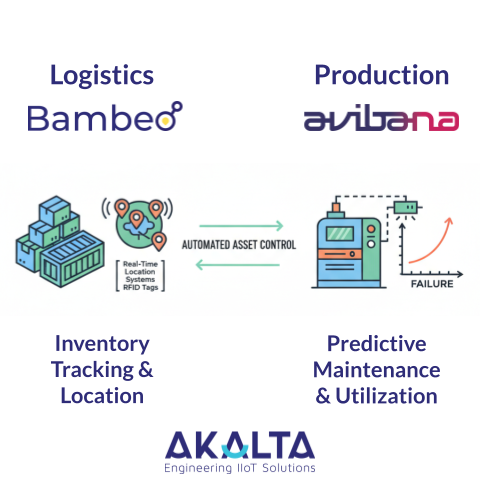
This article aims to demystify AAC, explaining the two essential pillars of this technology and how platforms like Bambeo and Avibana by Akalta provide a simple, step-by-step path to implementing control and securing maximum operational efficiency.
Pillar 1: Total Visibility and Process Traceability (Knowing What and Where)
The first, and most fundamental, challenge in any manufacturing environment is a logistical one: simply knowing what you have and where it is located at any given moment.
Imagine a machine shop equipped with hundreds of expensive gauges, molds, and specialized tools. If a technician spends 30 minutes a day searching for a tool that should be readily available, that wasted time quickly adds up to hundreds of lost production hours annually. If a high-value shipping container goes missing in a sprawling yard, replacing it is a massive, unnecessary expense driven solely by a lack of real-time location data.
The Limitations of Manual Control
The current reliance on barcodes or manual spreadsheets is the root cause of this chaos:
- Line-of-Sight Dependency (Barcodes): To read a barcode, you need a person, a scanner, and a clear view of the label. This means you can only count one item at a time, making bulk inventory slow and highly susceptible to human error.
- Static Data: A spreadsheet only indicates when an item was last updated. The moment it leaves that spot, the data is obsolete.
The Technology of Instant Tracking
Automated Asset Control uses two core technologies to eliminate manual tracking:
A. RFID (Radio Frequency Identification)
Think of an RFID tag as a “smart label” that can be read instantly without being seen. When a tagged item passes near an RFID reader (which can be fixed at a gate, or handheld), the reader emits radio waves that activate the tag. The tag sends back its unique ID.
- Bulk Reading: Crucially, a single reader can identify dozens or even hundreds of items simultaneously. A fully packed pallet can be inventoried in one second, eliminating the need to open boxes or scan individual items.
- Automatic Process Verification: By placing fixed readers at key production checkpoints (e.g., entering a quality control station or moving to the next assembly stage), the system automatically registers the movement, creating a seamless, time-stamped history.
B. RTLS (Real-Time Location Systems)
For assets that require constant, precise location awareness (like vehicles, high-value calibration tools, or personnel), RTLS (often using technologies like Bluetooth Low Energy) acts as an “indoor GPS.”
- Constant Monitoring: Small, battery-powered tags constantly broadcast their location. A network of receivers installed throughout the facility triangulates the signal, showing the asset’s location on a digital map in real-time. This prevents loss and dramatically cuts search time.
Bambeo: The Platform for Total Visibility
Akalta’s Bambeo platform is the central brain that manages this identification data. Bambeo is specialized in the identification, tracking, traceability, and management of assets or people within production processes.
- Real-Time Inventory and Location Mapping: Bambeo takes the constant stream of RFID and RTLS data and plots it on a digital layout of your facility, giving staff immediate answers to “Where is Asset X?” This eliminates the practice of over-purchasing tools that are merely lost.
- Automated Traceability (ProcessLog): Bambeo ensures that every step of a production or quality process is verified. It records the asset’s entry and exit from pre-defined zones, creating an unalterable ProcessLog that is essential for compliance and auditing. This ensures, for example, that a component has completed its paint cycle before moving to assembly.
- Simplified Operations: Bambeo’s mobile applications allow warehouse staff to perform essential tasks like asset verification and inventory checks using RFID or barcode scanning, ensuring data is instantly and accurately registered in the central system, minimizing human error and resistance to change.
Pillar 2: Predictive Insight and Condition Monitoring (Knowing How and When)
Achieving full logistical control (Pillar 1) brings enormous cost savings, but the next level of efficiency lies in controlling your machinery to prevent operational failures. This is the domain of Predictive Maintenance (PdM).
In manufacturing, relying on Reactive Maintenance (fixing it when it breaks) leads to catastrophic unplanned downtime, which can cost millions per hour. Preventive Maintenance (servicing based on calendar dates) is better. Still, it is wasteful, as parts are often replaced too early, or worse, problems that develop rapidly between service intervals are missed.
The core role of AAC here is to replace guesswork with data, enabling the machine to accurately report its health status.
The Technology That Gives Machines a Voice
- IoT Sensors: These small, rugged devices are the eyes and ears of the machine. They constantly measure vital signs, including vibration (the clearest indicator of mechanical health), temperature (a sign of friction or stress), and other parameters such as pressure or current.
- Condition Monitoring (CM): This is the process of continuously monitoring these parameters to spot early symptoms of deterioration. For instance, a bearing doesn’t fail instantly; it sends increasingly strong signals via subtle changes in its vibration pattern weeks or months before failure.
Avibana: The Platform for Prediction
Akalta’s Avibana platform is the specialized engine for Condition Monitoring and Predictive Maintenance. Avibana takes the complex, high-frequency data from industrial sensors and transforms it into clear, actionable health warnings.
- Advanced Data Interpretation: Avibana captures both simple scalar data (like average temperature) and complex dynamic data (like raw vibration waveforms). Crucially, it automatically performs the heavy lifting, calculating complex diagnostic parameters such as Crest Factor (an indicator of impulsive faults) and Overall RMS (a measure of vibration severity).
- The Early Warning System: Avibana allows engineers to define smart alarms based on these calculated health metrics. If the machine’s vibration level crosses a pre-set warning threshold, Avibana sends an instant notification. This allows the maintenance team to schedule a repair during the next planned break, eliminating unplanned downtime—the single biggest financial benefit of PdM.
- Asset Lifecycle Management: Beyond just alarms, Avibana maintains a complete, historical timeline of an asset’s health. This allows for superior decision-making, such as comparing the long-term performance of similar equipment or determining the optimal time to retire an old asset based on its maintenance history.
The Combined Strategic Power of Akalta’s Platforms
The ultimate benefit of Automated Asset Control is realized when the two pillars—tracking/traceability and condition monitoring—work together seamlessly, managed by the combined intelligence of Bambeo and Avibana.
When a manufacturer adopts both platforms, they gain control over the full lifecycle of their assets:
- From Purchase to Deployment (Bambeo): An asset is purchased, an RFID tag is applied, and Bambeo registers its existence, initial location, and value.
- During Operation (Avibana): The asset operates while Avibana monitors its health, ensuring performance and preventing failure. If Avibana detects an anomaly, it triggers a “Failure Risk” alert.
- Maintenance and Repair (Integration): An engineer uses the Avibana alert to diagnose the issue. That issue (a required repair) is automatically logged as an event in the system. The repair team uses the real-time location from Bambeo to find the asset immediately. Once the asset is repaired, the event is closed in Avibana, and the status update is shared with the rest of the business systems.
This complete, integrated loop is essential because it eliminates the data silos that plague manufacturing. The maintenance status (from Avibana) is automatically linked to the location and utilization data (from Bambeo), ensuring that all business decisions—from inventory replacement to scheduling maintenance—are based on a single, verified source of truth.
Furthermore, both platforms are designed with an integration-first philosophy. They use industry standards like MQTT (for device input) and REST APIs (for business systems) to ensure they connect easily with your existing ERP (Enterprise Resource Planning) and CMMS (Computerized Maintenance Management System) platforms. Your maintenance team doesn’t have to check multiple screens; the data flows where it’s needed.
Conclusion: From Chaos to Competitive Edge
Automated Asset Control is not a luxury; it is a necessity for any modern manufacturing operation aiming for global competitiveness. The shift from manual tracking and reactive maintenance to real-time visibility and predictive insights offers a powerful return on investment.
By leveraging smart technologies like RFID and specialized platforms like Bambeo (for tracking and inventory) and Avibana (for machine health and prediction), manufacturers can:
- Eliminate Search Time and Over-Purchasing: Achieve 99% inventory accuracy and instant asset location.
- Secure Zero Unplanned Downtime: Schedule repairs proactively based on real-time condition, not calendar dates.
- Ensure Compliance: Maintain an auditable, continuous record of process execution and maintenance history.
The future of manufacturing relies on knowing everything about every asset, all the time. Automated Asset Control makes this possible, moving your operation from the chaos of guesswork to a state of total, predictable efficiency.